


Saltguard Penetrating Water and Salt Barrier - Bulk
Saltguard Penetrating Water and Salt Barrier - Bulk - 55 Gallon is backordered and will ship as soon as it is back in stock.

-
Sale
Prosoco
Concrete Hardener, Densifier and Dustproofer - LS/CS
Sale price$61.30 – $227.25Save up to $25.25Unit price -
-
Sale
Prosoco
Sale price $291.75 Was: Regular price $320.93 Save $29.18Unit price -
-
Sale
Prosoco
Cat 5 R Guard Elastomeric Weatherproofing Membrane
Sale price$793.50 – $17,670.00Save up to $1,963.33Unit price -
-
Sale
-
-
Sale
Prosoco
Prosoco Consolideck LS Lithium Silicate Concrete Densifier
Sale price$398.16 – $428.50Save up to $70.50Unit price -
-
Sale
Prosoco
Cleaner/Degreaser Commercial-Strength Detergent
Sale price$288.73 – $9,981.33Save up to $1,109.04Unit price -
-
Sale
Prosoco
Consolideck BD1 Concrete Floor Densifier & Hardener
Sale price$909.58 – $6,298.67Save up to $699.85Unit price -
-
Sale
Prosoco
First Cut Concrete Slurry Cleaner
Sale price $295.58 Was: Regular price $325.14 Save $29.56Unit price -
-
Sale
Prosoco
DensiKure Concrete Curing Compound
Sale price $368.08 Was: Regular price $404.89 Save $36.81Unit price -
-
Sale
Prosoco
R Guard Porous Prep Water-Based Sealer - Case of 4 Gallons
Sale price $399.20 Was: Regular price $439.12 Save $39.92Unit price -
-
Sale
-
-
Sale
Prosoco
First Cut with Densifier - 5 Gallon
Sale price $363.58 Was: Regular price $399.94 Save $36.36Unit price -
-
Sale
-
-
Sale
Prosoco
R-Guard FastFlash Liquid Flashing & Waterproofing Compound
Sale price$655.60 – $684.33Save up to $68.43Unit price -
-
Sale
Prosoco
R Guard Fast Flash Roller Grade Waterproofing Membrane Compound - 2 Gallons
Sale price $354.73 Was: Regular price $390.20 Save $35.47Unit price -
-
Sale
-
-
Sale
-
-
Sale
Prosoco
R-Guard Cat 5 Rain Screen Air & Water Barrier Membrane - 5 Gallon
Sale price $833.17 Was: Regular price $916.49 Save $83.32Unit price -
-
Sale
Prosoco
R Guad Cat 5 ICF Fluid Applied Air & Water Barrier Membrane
Sale price$793.50 – $17,670.00Save up to $1,963.33Unit price -
-
Sale
Prosoco
Prosoco Asphalt Tar Remover - 25 Gallons
Sale price $1,070.83 Was: Regular price $1,177.91 Save $107.08Unit price -
-
Sale
Prosoco
Prosoco Sure Klean 101 Lime Solvent Concentrated Masonry Cleaner
Sale price$444.58 – $818.58Save up to $81.86Unit price -
-
Sale
Prosoco
Natural Stone Treatment WB Water Repellent
Sale price$298.07 – $354.83Save up to $35.48Unit price -
-
Sale
Prosoco
Natural Stone Treatment Water Repellent
Sale price$399.07 – $474.00Save up to $47.40Unit price -
-
Sale
Prosoco
Saltguard Penetrating Water and Salt Barrier
Sale price$343.47 – $398.33Save up to $39.83Unit price -
-
Sale
Prosoco
VB Vapor & Air/Water Resistive Barrier
Sale price $276.25 Was: Regular price $303.88 Save $27.63Unit price -
-
Sale
Prosoco
Siloxane PD Pre-Diluted Water Repellent - Bulk
Sale price$2,583.17 – $6,650.67Save up to $738.96Unit price -
-
Sale
Prosoco
R Guard Joint & Seam Filler - Bulk
Sale price$17,742.20 – $23,797.50Save up to $1,252.50Unit price -
-
Sale
Prosoco
R-Guard Spray Wrap MVP Air & Water-Resistive Barrier - Bulk
Sale price$2,601.50 – $7,021.33Save up to $780.15Unit price -
-
Sale
Prosoco
Sale price $19,748.00 Was: Regular price $21,942.22 Save $2,194.22Unit price -
-
Sale
Prosoco
R-Guard FastFlash Liquid Flashing & Waterproofing Compound - Pallet
Sale price$21,287.00 – $28,575.00Save up to $3,175.00Unit price -
-
Sale
Prosoco
First Cut with Densifier - 55 Gallon
Sale price $3,758.33 Was: Regular price $4,134.16 Save $375.83Unit price -
-
Sale
Prosoco
Blended Densifier Concrete Surface Hardener - Bulk
Sale price$2,716.08 – $6,298.67Save up to $699.85Unit price -
-
Sale
Prosoco
Consolideck Guard EXT Exterior Concrete Protective Coating - 55 Gallon
Sale price $5,850.17 Was: Regular price $6,435.19 Save $585.02Unit price -
-
Sale
Prosoco
Prosoco Sure Klean Tilt-Up Klean Bond Breaker Residue Cleaner - 55 Gallon
Sale price $3,553.92 Was: Regular price $3,909.31 Save $355.39Unit price -
-
Sale
Prosoco
Saltguard WB Water-Based Chloride Screening Sealer - Bulk
Sale price$3,356.83 – $7,693.33Save up to $854.82Unit price -
-
Sale
Prosoco
Saltguard Penetrating Water and Salt Barrier - Bulk
Sale price$4,214.83 – $9,880.00Save up to $1,097.78Unit price -
-
Sale
Prosoco
Natural Stone Treatment Water Repellent - Bulk
Sale price$5,036.17 – $13,064.00Save up to $1,451.56Unit price -
-
Sale
Prosoco
Natural Stone Treatment WB Water Repellent - Bulk
Sale price$3,785.83 – $9,432.62Save up to $510.91Unit price -
-
Sale
-
-
Sale
-
-
Sale
Prosoco
Concrete Hardener, Densifier and Dustproofer - LS/CS - Bulk
Sale price$2,277.00 – $8,157.58Save up to $815.76Unit price -
-
Sale
Prosoco
Sale price $8,681.20 Was: Regular price $9,549.32 Save $868.12Unit price -
-
Sale
Prosoco
All Surface Cleaner and Degreaser - 55 Gallon
Sale price $2,757.33 Was: Regular price $3,033.06 Save $275.73Unit price -
-
Sale
Prosoco
Strippable Masking Temporary Protective Coating
Sale price $603.42 Was: Regular price $663.76 Save $60.34Unit price -
-
Sale
-
-
Sale
Prosoco
Iron Stain Remover - Case of 4
Sale price $843.40 Was: Regular price $927.74 Save $84.34Unit price -
-
Sale
Prosoco
Enviro Klean 2010 All Surface Cleaner and Degreaser
Sale price$86.64 – $279.92Save up to $27.99Unit price -
-
Sale
-
-
Sale
Prosoco
PROSOCO BMC II White/Pastel Base Color Coating - 5 Gallon
Sale price $694.83 Was: Regular price $764.31 Save $69.48Unit price -
-
Sale
Prosoco
PROSOCO BMC II Tint Base - Water Repellent Color Coating
Sale price $662.67 Was: Regular price $728.94 Save $66.27Unit price -


Product Description
Saltguard Penetrating Water and Salt Barrier for Concrete and Masonry
Technical Specifications
| Specification | Details |
|---|---|
| SKU | 46060-01GALCS |
| Base | Solvent-based |
| Type | Silane/siloxane water repellent and chloride screen |
| Applicable Surfaces | Concrete, masonry, concrete block, clay and concrete brick |
| Surface Orientation | Horizontal and vertical |
| Film-Forming | Non film-forming |
| Primary Function | Water repellency and chloride salt barrier; reduces rebar corrosion and surface spalling |
| Form | Clear, slightly yellow liquid; mild petroleum odor |
| Specific Gravity | 0.794 |
| Weight per Gallon | 6.61 lbs |
| Active Content | 11% |
| Total Solids | 9% |
| VOC Content | 713 g/L |
| Flash Point | 127°F (53°C) ASTM D 3278 |
| Coverage Rate | 50–300 sq ft/gal (see Product Data Sheet) |
| Application Temperature | 40–90°F (4–32°C) air and surface |
| Shelf Life | 2 years in tightly sealed, unopened container |
| pH | Non-applicable |
| VOC Restrictions | May not be available in AZ, CA (CARB), CO, CT, DE, DC, IL, IN, ME, MD, MA, NH, NJ, NY, OH, PA, RI, SCAQMD, UT, VA (Metro DC), VA (Richmond), and Canada |
| Manufactured | Lawrence, Kansas (BABA compliant) |
PROSOCO Saltguard is a solvent-based, silane/siloxane water repellent and chloride screen engineered for concrete and masonry surfaces, including concrete block and clay and concrete brick. Designed for both horizontal and vertical applications, it protects surfaces from moisture intrusion and the chemical attack of chloride salts — the leading causes of rebar corrosion and surface spalling. Saltguard is a proven solution for contractors working on infrastructure, commercial, and site-work projects where long-term concrete durability is a priority.
Unlike film-forming sealers that sit on the surface and can create slip hazards or trap moisture, Saltguard penetrates deeply into the substrate to repel water and chlorides from within. Treated surfaces remain vapor-permeable, allowing the structure to breathe naturally while still resisting water and salt-driven deterioration.
Key Features & Benefits
Deep Penetrating Protection
Saltguard penetrates deeply into concrete and masonry rather than forming a surface film. This means protection works from within the substrate, providing durable resistance to moisture intrusion without altering the surface appearance or texture in most cases.
Effective Chloride Ion Screen
Saltguard acts as a chloride screen, reducing the penetration of deicing salts, road salts, and salt air into the substrate. This directly reduces the risk of rebar corrosion and the freeze-thaw spalling damage that follows chloride-induced deterioration — critical for bridges, parking structures, and coastal installations.
Non Film-Forming — No Slippery Surface
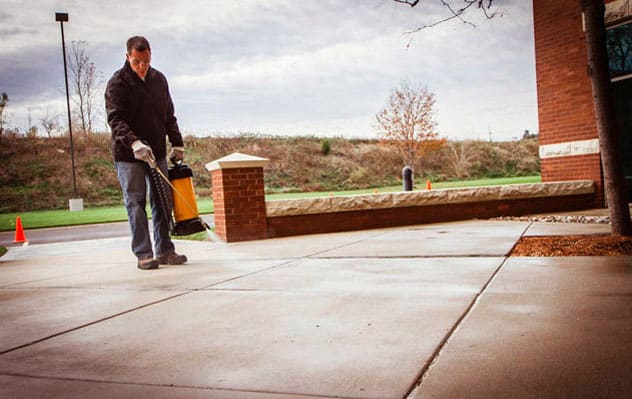
Because Saltguard does not form a surface film, it will not create a slippery walking surface on treated horizontal areas such as sidewalks and pavers. This makes it suitable for pedestrian areas where surface traction must be maintained after treatment.
Vapor-Permeable — Surfaces Breathe
Treated surfaces remain breathable after application, allowing entrapped moisture vapor to escape naturally. This prevents the moisture-trapping that can cause blistering, delamination, or accelerated deterioration under a sealed surface film.
Alkaline Stable — Suitable for New Green Concrete
Saltguard is alkaline stable, making it compatible with new concrete as early as 14 to 28 days after placement. Contractors do not need to wait for full carbonation of the concrete surface before applying protection.
Resists Water Penetration Over Shrinkage Cracks
Saltguard resists water penetration when applied over existing shrinkage cracks of 0.02 inches or less. This provides an added measure of protection on surfaces with minor surface cracking, without requiring crack repair prior to application in those cases.
Common Applications
Sidewalks and Flatwork
Saltguard is suitable for horizontal concrete surfaces such as sidewalks and slabs where deicing salts are applied seasonally and surface spalling is a recurring maintenance concern.
Tile and Brick Pavers
Applied to clay and concrete brick pavers, Saltguard provides water repellency and chloride protection without altering surface traction or appearance.
Retaining Walls
Saltguard protects vertical masonry and concrete retaining walls from moisture intrusion and salt-driven deterioration, extending service life in exposed or high-chloride environments.
Bridge Pilings and Infrastructure
For bridge pilings and other structural concrete exposed to deicing chemicals or marine environments, Saltguard reduces chloride penetration that leads to rebar corrosion and structural degradation.
Coastal Structures
In coastal areas where salt air is a constant threat, Saltguard reduces chloride penetration into concrete and masonry facades, walls, and flatwork, limiting salt-air-driven surface deterioration.
Concrete Block and Masonry Walls
Saltguard protects concrete block walls and masonry assemblies from moisture intrusion and waterborne contaminants including mud splashes, preventing deep-seated staining and water damage.
Compatible Materials
- Concrete (horizontal and vertical)
- Masonry
- Concrete block
- Clay brick
- Concrete brick
Product Documents
- Product Data Sheet
- Safety Data Sheet
- Safety Data Sheet (Spanish)
- SDS Canadian French
- VOC Compliance
- Build America, Buy America Act Certification
Application Instructions
Surface Preparation
- Clean surfaces thoroughly with an appropriate cleaner to remove all surface dirt, oil, grease, and other contaminants for maximum penetration.
- Ensure new concrete is thoroughly cured before application. New concrete should be 14–28 days old at minimum.
- Do not apply where condensation is present on the surface.
- If possible, install all caulking, patching, and joint sealants before application. If impractical, special joint preparation may be required to ensure caulk adhesion after treatment.
- Allow masonry to thaw completely if freezing conditions exist prior to application.
Environmental Conditions
- Apply when air and masonry surface temperatures are between 40°F and 90°F (4°C and 32°C).
- On warm days, apply early in the day and to shaded areas.
Protection of Surrounding Areas
- Protect people, vehicles, nearby property, metal, anodized aluminum, glass, plants, and all non-masonry surfaces from product, fumes, spray, and wind drift.
- Divert and/or protect auto and pedestrian traffic during application.
- When applying to exteriors of occupied buildings, cover all windows, exterior intakes, and air conditioning vents and shut down air handling equipment during application and until vapors have dissipated.
Application
- Apply using a high volume, low-pressure spray (less than 50 psi) with solvent-resistant hoses and gaskets. Use fan spray tips to avoid atomization of the material.
- For small-scale application or where spray is not appropriate, apply by brush or roller. Contact PROSOCO Customer Care for guidance.
- Ensure fresh air entry and cross ventilation during application and drying.
- Extinguish all flames, pilot lights, and other potential ignition sources during use and until all vapors are gone.
Storage and Handling
- Store in a cool, dry place away from potential ignition sources.
- Keep container tightly sealed when not dispensing.
- Shelf life is 2 years in a tightly sealed, unopened container.
Safety Data Summary
Safe Handling
- Always read the full label and Safety Data Sheet before use.
- Keep away from flames, pilot lights, and all ignition sources during application and until vapors have dissipated — product is flammable (flash point 127°F / 53°C).
- Ensure fresh air entry and cross ventilation during application and drying.
- Store in a cool, dry location away from ignition sources in a tightly sealed container.
- 24-Hour Emergency Information: INFOTRAC at 800-535-5053
Frequently Asked Questions
Q: Can Saltguard be applied to new concrete?
A: Yes. Saltguard is alkaline stable and is suitable for new "green" concrete that is 14–28 days old. For best performance, blanket or water curing is recommended for new concrete, and dissipating curing agents should be used. Remove all surface films and contaminants before application.
Q: Is Saltguard appropriate for use on natural stone?
A: Saltguard is not appropriate for use on limestone, marble, travertine, or other calcareous stones. For other natural stone types, always test on a representative area to ensure desired results before full application.
Q: Will Saltguard make horizontal surfaces slippery?
A: No. Saltguard is non film-forming and will not create a slippery surface, making it suitable for pedestrian areas such as sidewalks and pavers.
Q: Can Saltguard be used on surfaces that will receive paint or coatings?
A: Saltguard may not be suitable for surfaces that will receive paints or coatings. Always test on a representative area before full application if coatings will follow.
Q: Is Saltguard suitable for below-grade or constantly wet applications?
A: No. Saltguard is not recommended for below-grade applications and is not suitable for protecting surfaces subject to constant water spray.
Q: Does Saltguard comply with the Build America, Buy America Act?
A: Yes. PROSOCO has certified that Saltguard is in full compliance with the Build America, Buy America Act (BABAA) as mandated in the Infrastructure Investment and Jobs Act (IIJA). Product blending and packaging takes place in Lawrence, Kansas.
-
Sale
Husqvarna
Husqvarna Hepa Dust Extractor - 130 H
Sale price $6,253.20 Was: Regular price $6,948.00 Save $694.80Unit price -
-
Sale
Husqvarna
Husqvarna K 540i Power Cutting Saw
Sale price $944.10 Was: Regular price $1,049.00 Save $104.90Unit price -
-
Sale
-
-
Sale
Husqvarna
Sale price $2,444.40 Was: Regular price $2,716.00 Save $271.60Unit price -
-
Sale
-
-
 Sale
SaleHusqvarna
Sale price $1,614.60 Was: Regular price $1,794.00 Save $179.40Unit price -
 Sale
SaleHusqvarna
Sale price$118,153.29 – $122,841.00Save up to $13,649.00Unit price -
Sale
Husqvarna
Sale price $5,635.80 Was: Regular price $6,262.00 Save $626.20Unit price -


