


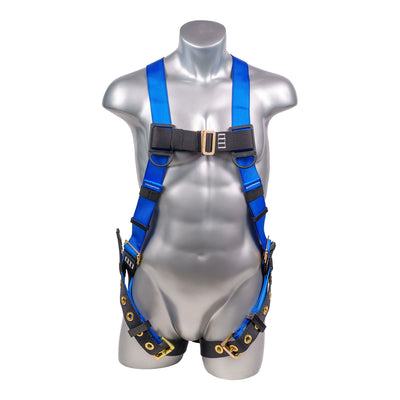
Mako Series Harness 5pt., Tongue and Buckle Leg Straps, Back D-Ring
Mako Series Harness 5pt., Tongue and Buckle Leg Straps, Back D-Ring - Small is backordered and will ship as soon as it is back in stock.
Safe & Secure Payments

Mako Series Harness 5pt., Tongue and Buckle Leg Straps, Back D-Ring - Small is backordered and will ship as soon as it is back in stock.
Product Description
Mako Series 5-Point Full Body Harness — Dorsal D-Ring with Tongue Buckle Leg Straps
The Palmer Safety Mako Series Full Body Harness (SKU: H212100031) is a 5-point adjustable fall arrest harness engineered for construction and trades professionals working at height. Featuring a dorsal D-ring for fall arrest connection, adjustable tongue buckle leg straps, and breakaway lanyard keepers, it is built to perform in demanding jobsite environments. Available in Universal, Small, 2XL, and 3XL sizing, it accommodates a user capacity of 130–420 lbs. and conforms to ANSI Z359.11-2021 and A10.32-2012 standards.
Technical Specifications
| Specification | Details |
|---|---|
| SKU | H212100031 |
| Harness Series | Mako |
| Adjustment Points | 5 |
| D-Ring Configuration | Dorsal (back, between shoulder blades) |
| Leg Straps | Tongue Buckle |
| User Capacity | 130–420 lbs. |
| Webbing Material | Polyester |
| Webbing Width | 1.73 in. (44mm) |
| Stitching Thread | High-tenacity polyester |
| Metal Component Material | Alloy Steel |
| Metal Component Finish | Silver or yellow golden galvanized |
| Color | Blue |
| Conforms To | ANSI Z359.11-2021, A10.32-2012 |
| Design Features | Dorsal D-ring, breakaway lanyard keepers, adjustable shoulder straps, adjustable tongue buckle legs, fall indicators |
Available Sizes
| Part Number | Color | Size |
|---|---|---|
| H212100031.SM | Blue | Small |
| H212100031 | Blue | Universal |
| H212100031.2XL | Blue | 2XL |
| H212100031.3XL | Blue | 3XL |
The Mako Series harness distinguishes itself with a broad user capacity range of 130–420 lbs. and a four-size lineup — including Universal, Small, 2XL, and 3XL — making it practical for diverse crews without requiring multiple harness models. The galvanized alloy steel hardware and high-tenacity polyester stitching are selected for durability in environments where corrosion and abrasion are ongoing concerns.
Key Features & Benefits
5-Point Adjustment System
Five independent adjustment points — including shoulder straps, torso, and tongue buckle leg straps — allow the harness to be precisely fitted to a wide range of body types. A properly fitted harness is critical to ensuring the dorsal D-ring remains correctly positioned between the shoulder blades for effective fall arrest.
Dorsal D-Ring for Fall Arrest
The single dorsal D-ring is positioned at the back between the shoulder blades, the required connection point for personal fall arrest subsystems such as lanyards and self-retracting lifelines. Per the instruction manual, the fall arrest subsystem must only be connected to this back attachment element — never to belt or ventral D-rings.
Tongue Buckle Leg Straps
Adjustable tongue buckle leg straps provide a secure, repeatable fit that can be tightened or loosened quickly on the jobsite. This closure style is straightforward to inspect and adjust, supporting compliance with the requirement to check adjustment points regularly during use.
Breakaway Lanyard Keepers
Integrated breakaway lanyard keepers allow unused lanyard legs to be parked safely on the harness, reducing snag hazards and keeping the work area organized. These keepers are designed for parking only and must not be used as load-bearing attachment points.
Fall Indicators
Built-in fall indicators provide a visible signal if the harness has been subjected to fall arrest forces, enabling supervisors and users to immediately identify equipment that must be removed from service. This supports the mandatory requirement to retire any harness involved in a fall event.
High-Tenacity Polyester Webbing and Stitching
The 1.73 in. (44mm) polyester webbing and high-tenacity polyester stitching thread are selected for strength and resistance to the mechanical stresses of fall arrest. Polyester webbing also offers better resistance to moisture and UV degradation compared to natural fiber alternatives, which are explicitly prohibited in fall protection systems.
Galvanized Alloy Steel Hardware
All metal components are alloy steel with a silver or yellow golden galvanized finish, providing corrosion resistance in outdoor and high-humidity construction environments. Hardware must be inspected before each use for deformities, unusual wear, or deterioration.
Common Applications
Personal Fall Arrest (Class A)
The primary application for this harness is as a component of a personal fall arrest system, connected via the dorsal D-ring to an energy-absorbing lanyard or self-retracting lifeline. The system must be rigged to limit free fall to 6 feet (1.8 m) per ANSI Z359.11.
Restraint Systems
The harness may be used as part of a restraint system to prevent a worker from reaching an unprotected edge or floor opening, typically paired with a lanyard or restraint line. Restraint systems must be rigged so that no vertical free fall is possible.
Work Positioning (Class P)
When equipped with appropriate side or belt-mounted D-rings, full body harnesses of this type can be used in work positioning systems that support the user at a work position. Work positioning subsystems must connect only to the designated lower hip-level D-rings — never to the dorsal fall arrest D-ring.
Ladder Climbing (Class L)
The harness can serve as a component of a climbing system on fixed ladders or other climbing structures, used in conjunction with a vertical cable or rail and climbing sleeve. Climbing systems must be rigged to limit free fall to 18 in. (0.46 m) or less.
Controlled Descent (Class D)
Harnesses with appropriate sternal or frontal D-ring configurations may be used for controlled descent applications connected to a descender or evacuation system. Refer to the full instruction manual for specific configuration requirements.
Rescue Operations (Class E)
Full body harnesses of this type can be used as a component of a rescue system; for confined space applications, harnesses with shoulder D-rings support entry and egress where worker profile is a concern. Rescue operations must be performed by trained and competent personnel.
Compatible Materials
- Concrete structures and formed surfaces
- Steel framing and structural members
- Fixed ladders and climbing structures (with appropriate climbing sleeve)
- Rebar and cross members (with large throat snap hooks rated at 3,600 lbs. or fixed structural elements only)
- Anchorages rated to support at least 5,000 lbs. per user for fall arrest applications (per OSHA 1926.500 and 1910.66)
- Palmer Safety approved connecting subsystems: energy-absorbing lanyards, self-retracting lifelines (SRLs), rope grabs, cable sleeves
- Self-locking connectors (snap hooks and carabiners) compatible in size, shape, and strength — minimum 5,000 lb. connector rating
Product Documents
- Download Tech Sheet
- Download Instruction Manual
- Download Harness Sizing Chart
- Download Declaration of Conformance
Application Instructions
Pre-Use Inspection
- Inspect all webbing for cuts, fraying, burns, chemical damage, or unusual wear before each use.
- Inspect all metal hardware (D-rings, buckles, keepers) for deformities, corrosion, or damage.
- Check fall indicators — if activated, remove the harness from service immediately.
- Verify all stitching is intact with no broken or pulled threads.
- Confirm the harness has not been subjected to a fall arrest event; if it has, remove from service.
Donning and Adjustment
- Hold the harness by the dorsal D-ring and allow all straps to hang freely; shake out any twists.
- Slip on the shoulder straps so the dorsal D-ring is positioned between the shoulder blades.
- Connect and adjust the chest strap at mid-sternum level.
- Adjust the torso/back plate position using the torso adjustment point.
- Pass each leg strap under the corresponding thigh and connect the tongue buckle; adjust for a snug but comfortable fit — you should be able to fit two fingers under each strap.
- Adjust shoulder straps so the dorsal D-ring sits centered between the shoulder blades.
- Verify all buckles are fully engaged and all excess webbing is secured.
Connecting the Fall Arrest Subsystem
- Connect the fall arrest subsystem (lanyard, SRL, energy absorber) only to the dorsal D-ring on the back.
- Use only self-locking connectors; verify each connector is fully closed and locked before use.
- Park unused lanyard legs on the breakaway lanyard keepers — do not use keepers as load-bearing attachment points.
- Ensure the anchorage point is capable of supporting at least 5,000 lbs. per user for fall arrest applications.
- Rig the system to limit free fall to 6 feet (1.8 m) and verify sufficient clearance below the user to arrest a fall before striking the ground or any obstruction.
Post-Use and Storage
- After each use, inspect the harness again for any signs of damage or wear.
- If the harness was involved in a fall arrest event, remove it from service immediately and contact Palmer Safety regarding replacement.
- Store away from UV light, heat sources, chemicals, and sharp edges.
- Do not expose to slag, hot sparks, or open flames.
- Have the harness inspected by a qualified person on a regular basis in addition to pre-use inspections.
Safety Data Summary
Hazard Information
- Equipment subjected to a fall arrest event must be immediately removed from service — continued use after a fall can result in serious injury or death.
- Swing falls (anchorage not directly above the fall point) can cause serious injury or death; minimize by working as close to the anchorage as possible.
- Extended suspension in a full body harness is not an intended application; suspension trauma is a recognized hazard — a rescue plan must be in place before work begins.
- Do not use near moving machinery or electrical hazards.
- Do not expose webbing or synthetic components to slag, hot sparks, open flames, or other heat sources.
- Do not expose to chemicals, caustic environments, or high levels of organic acids or bases without confirming compatibility with Palmer Safety.
- UV exposure can degrade synthetic webbing — avoid prolonged UV exposure during storage.
- Pregnant women and minors should not use this equipment.
- Consult a physician if there is any reason to doubt a user's ability to safely withstand fall arrest forces.
Personal Protective Equipment
- Use as part of a complete personal fall arrest system including a compatible connecting subsystem and rated anchorage.
- Use heat-resistant materials when working near slag, sparks, or open flames.
- Additional PPE appropriate to environmental hazards (chemical, electrical, thermal) must be selected based on site conditions.
Safe Handling
- Do not alter the equipment in any way; repairs must be performed only by the manufacturer or authorized entities.
- Never use fall protection equipment for towing or hoisting.
- Never use natural fiber materials (manila, cotton, etc.) as part of a fall protection system.
- Ensure all connectors are self-locking, fully closed, and locked before use; visually inspect for closure and lock.
- Do not connect two active components (snap hooks or carabiners) to a single D-ring simultaneously.
- Do not load connectors against the gate; ensure gates cannot be captured by structural members.
- Remove obstructions, debris, and recognized hazards from the work area before use.
- Work in pairs and have a rescue plan and means to implement it before beginning work at height.
- Store equipment away from UV light, heat, chemicals, and sharp or abrasive surfaces.
Frequently Asked Questions
Q: What is the maximum user weight capacity for this harness?
A: The Mako Series harness is rated for a user capacity of 130–420 lbs., which includes the combined weight of the worker, clothing, and tools. Ensure all other components in your fall protection system are also rated appropriately for your application.
Q: Which D-ring should be used for fall arrest?
A: The fall arrest subsystem (lanyard, SRL, energy absorber) must be connected only to the dorsal D-ring located on the back between the shoulder blades. Belt-mounted or ventral D-rings are designated for work positioning or restraint systems only and must never be used for fall arrest.
Q: What should I do if the harness has been involved in a fall?
A: Remove the harness from service immediately after any fall arrest event. The fall indicators will show visible activation. Contact Palmer Safety or your distributor regarding replacement — do not return the harness to service.
Q: What standards does this harness conform to?
A: The Mako Series Full Body Harness meets or exceeds ANSI Z359.11-2021 and A10.32-2012.
Q: Can I use snap hooks to connect to the web loops on the harness?
A: No. Do not use snap hooks to connect to web loops. Use a self-locking carabiner to connect to a web loop, and ensure the carabiner cannot cross-gate load. Some lanyards are designed to choke onto a web loop — refer to the subsystem manufacturer's instructions.
Q: How often should the harness be inspected?
A: The harness must be inspected before each use by the authorized user. In addition, a qualified person must inspect all equipment on a regular basis as part of an ongoing fall protection program.
-
Sale
Husqvarna
Husqvarna Hepa Dust Extractor - 130 H
Sale price $6,253.20 Was: Regular price $6,948.00 Save $694.80Unit price -
-
Sale
Husqvarna
Husqvarna K 540i Power Cutting Saw
Sale price $944.10 Was: Regular price $1,049.00 Save $104.90Unit price -
-
Sale
-
-
Sale
Husqvarna
Sale price $2,444.40 Was: Regular price $2,716.00 Save $271.60Unit price -
-
Sale
-
-
 Sale
SaleHusqvarna
Sale price $1,614.60 Was: Regular price $1,794.00 Save $179.40Unit price -
 Sale
SaleHusqvarna
Sale price$118,153.29 – $122,841.00Save up to $13,649.00Unit price -
Sale
Husqvarna
Sale price $5,635.80 Was: Regular price $6,262.00 Save $626.20Unit price -


