


Hook Carabiner .67"
Hook Carabiner .67" is backordered and will ship as soon as it is back in stock.
Safe & Secure Payments

Hook Carabiner .67" is backordered and will ship as soon as it is back in stock.
Product Description
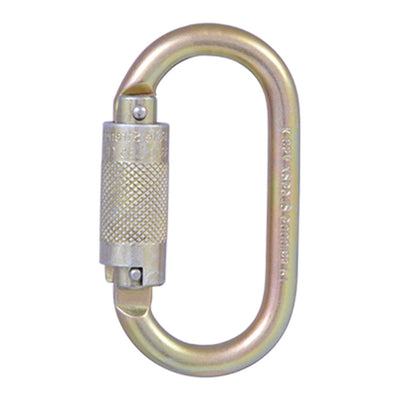
Hook Carabiner .67" — ANSI Z359.12-2009 Compliant Steel Twist Lock Connector
The Palmer Safety C111 Hook Carabiner is an oval-shaped, alloy steel self-locking carabiner designed for use as an anchorage connector or system connector in personal fall arrest, restraint, work positioning, suspension, and rescue systems. Built from round steel bar with a yellow chromate finish, it features a quarter-turn auto nut rotation locking mechanism that provides a secure, self-closing and self-locking gate. With a 0.67" gate opening and a minimum breaking strength of 5,000 lbs., this carabiner meets or exceeds ANSI Z359.12-2009 and is intended for use by trained trades professionals operating in elevated work environments.
Technical Specifications
| Specification | Details |
|---|---|
| Model | C111 |
| Gate Opening | 0.67" (17 mm) |
| Lock Type | Steel twist lock / Quarter turn auto nut rotation |
| Minimum Gate Opening (stated) | 1/2" |
| Gate Face Strength | 3,600 lbs. (16 kN) |
| Gate Side Strength | 3,600 lbs. (16 kN) |
| Major Axis Strength | 3,600 lbs. (16 kN) |
| Minor Axis Strength | 3,600 lbs. (16 kN) |
| Proof Load | 5,000 lbs. (23 kN) |
| Minimum Breaking Strength | 5,000 lbs. (23 kN) |
| Material | Alloy Steel |
| Finish | Yellow chromate (Zinc Plated / Galvanized) |
| Shape | Oval shaped, made of round steel bar |
| Weight | 0.35 lbs. ± 0.02 lbs. (160 gms) |
| Standard Compliance | Meets or exceeds ANSI Z359.12-2009 |
| Maximum User Capacity | 420 lbs. combined weight (person, clothing, tools, etc.) |
| Country of Origin | India |
Model Comparison Table
| Model | Material | Finish | Gate Face Strength | Gate Side Strength | Proof Load | Min. Breaking Strength | Gate Opening | Approx. Weight |
|---|---|---|---|---|---|---|---|---|
| C111 | Alloy Steel | Zinc Plated / Galvanized | 3,600 lbs / 16 kN | 3,600 lbs / 16 kN | 5,000 lbs / 23 kN | 3,600 lbs / 16 kN | 0.67" / 17 mm | 0.35 lbs / 160 gms |
| C113 | Alloy Steel | Zinc Plated / Galvanized | 3,600 lbs / 16 kN | 3,600 lbs / 16 kN | 5,000 lbs / 23 kN | 3,600 lbs / 16 kN | 0.84" / 21 mm | 0.54 lbs / 265.09 gms |
| S00140 | Alloy Steel | Zinc Plated / Galvanized | 3,600 lbs / 16 kN | 3,600 lbs / 16 kN | 5,000 lbs / 23 kN | N/A | 2.36" / 60 mm | 1.80 lbs / 816 gms |
| C134 | Alloy Steel | Zinc Plated / Galvanized | 3,600 lbs / 16 kN | 3,600 lbs / 16 kN | 5,000 lbs / 23 kN | 3,600 lbs / 16 kN | 1.97" / 50 mm | 0.46 lbs / 748 gms |
| SRL170 | Alloy Steel | Zinc Plated / Galvanized | 3,600 lbs / 16 kN | 3,600 lbs / 16 kN | 5,000 lbs / 23 kN | N/A | 2.36" / 60 mm | 1.80 lbs / 816 gms |
| SRL169 | Alloy Steel | Zinc Plated / Galvanized | 3,600 lbs / 16 kN | 3,600 lbs / 16 kN | 5,000 lbs / 23 kN | 3,600 lbs / 16 kN | 1.97" / 50 mm | 0.46 lbs / 748 gms |
The C111 distinguishes itself with a compact 0.67" gate opening in an oval profile machined from round alloy steel bar, delivering uniform load distribution across both the major and minor axes at 3,600 lbs. each. The quarter-turn auto nut rotation locking mechanism provides a positive, audible lock confirmation that reduces the risk of unintentional gate opening compared to non-locking connectors. At 0.35 lbs., it is among the lightest options in the Palmer Safety connector lineup while maintaining full ANSI Z359.12-2009 compliance.
Key Features & Benefits
Quarter-Turn Auto Nut Rotation Locking Gate
The steel twist lock mechanism requires a deliberate quarter-turn action to open, providing a self-closing and self-locking gate that reduces the risk of accidental disengagement during use. This locking design complies with ANSI Z359.12-2009 requirements for self-locking connectors used in personal fall protection systems.
High-Strength Alloy Steel Construction
Manufactured from alloy steel round bar in an oval profile, the C111 delivers a minimum breaking strength of 5,000 lbs. (23 kN) and gate face and side strengths of 3,600 lbs. (16 kN). This construction provides the load capacity required for fall arrest, work positioning, and rescue applications.
Zinc Plated / Galvanized Finish
The zinc plated galvanized finish provides corrosion resistance for use in outdoor and variable weather conditions. Users working near seawater or other corrosive environments should increase inspection frequency to monitor for corrosion damage.
Compact 0.67" Gate Opening
The 0.67" (17 mm) gate opening is sized for connection to compatible D-rings and anchorage connectors, helping ensure a tight, properly fitted connection that reduces the risk of roll-out. Proper sizing of the connecting element is critical — the carabiner must be connected to a compatible, properly sized component.
Lightweight at 0.35 lbs.
Weighing only 0.35 lbs. (160 gms), the C111 minimizes added load on the worker's harness and lanyard system without sacrificing rated strength. This is particularly relevant for trades professionals who carry multiple connectors or work in elevated positions for extended periods.
ANSI Z359.12-2009 Compliant
The C111 meets or exceeds ANSI Z359.12-2009, the standard governing connectors used in personal fall arrest systems. Compliance with this standard is required by OSHA regulations for fall protection equipment used on construction sites.
Common Applications
Fall Arrest Systems
Used as an anchorage connector or system connector in personal fall arrest systems (PFAS) incorporating a full body harness and connecting subsystem such as a self-retracting lifeline. Maximum permissible free fall in a fall arrest application is 6 feet per ANSI Z359.1.
Restraint Systems
Connects lanyards or restraint lines to anchorages in restraint systems designed to prevent the user from reaching a fall hazard, such as leading edge roof work where no vertical free fall is possible.
Work Positioning Systems
Functions as a connector in work positioning systems that support the user at the work position, with a maximum permissible free fall of 2 feet in this application type.
Suspension Systems
Serves as a connector in suspension systems that suspend or transport the user vertically, typically used in conjunction with a full body harness, chair, and lanyard.
Rescue Systems
Can be used as a connector in rescue systems incorporating a full body harness and connecting subsystem to retrieve a victim in a rescue application.
Back-Up Fall Arrest
Suitable for use as a back-up fall arrest connector on Y-lanyards and similar dual-leg configurations where a secondary connection point is required.
Compatible Materials
- Properly sized D-rings (anchorage connectors)
- Lanyards and energy-absorbing lanyards
- Self-retracting lifelines (SRLs)
- Full body harness dorsal and sternal attachment points
- Tie-off adaptors
- Y-lanyards (dual-leg configurations)
- Rescue lines
Product Documents
Application Instructions
Before Each Use — Inspection
- Visually inspect the carabiner for worn or damaged parts, sharp edges, burrs, cracks, distortion, or corrosion.
- Verify the gate closes and locks fully. Light passing through gate holes indicates the snap hook or carabiner is not locked — do not use.
- Inspect all other fall arrest or restraint equipment according to the respective manufacturer's instructions.
- Do not use the equipment if inspection reveals any unsafe condition.
Planning Your System
- Plan your fall arrest, restraint, work positioning, suspension, or rescue system before starting work, considering all factors affecting safety.
- Ensure the anchorage selected is capable of sustaining the required static loads: at least 5,000 lbs. (22.2 kN) per user for non-certified fall arrest anchorages per OSHA 1926.500 and 1910.66.
- For work positioning anchorages, the structure must sustain at least 3,000 lbs. or twice the potential impact load, whichever is greater.
- For restraint anchorages, the structure must sustain at least 1,000 lbs. (4.5 kN) for non-certified anchorages.
- Ensure enough fall clearance exists in the fall path to prevent striking an object — clearance required depends on the connecting subsystem type and anchorage location.
- Work as directly below the anchorage as possible to minimize swing fall risk.
Making Connections
- Connect the carabiner only to a compatible, properly sized D-ring or anchorage connector. An undersized or irregular connecting element can cause roll-out.
- Do not connect to a D-ring that already has another connector attached.
- Do not connect in a manner that would result in a load on the gate.
- Ensure the gate is fully closed and locked after making the connection.
- Only one personal protective system may be connected to the connector or anchorage connector at any time, except in emergency situations.
Periodic Formal Inspection
- A formal inspection must be performed at least every six months by a competent person other than the user.
- The snap hook or carabiner must be inspected by a competent person, other than the user, at least annually.
- Adjust inspection frequency based on conditions of use or exposure, including corrosive environments.
- Record all inspection results in the inspection and maintenance log.
Removal from Service
- Immediately remove the carabiner from service if it has been subjected to fall arrest or impact forces.
- Remove from service any product exhibiting deformities, unusual wear, or deterioration.
- Do not attempt to repair — repairs must be performed only by the manufacturer or persons authorized in writing by the manufacturer.
- Do not alter the equipment in any way.
Safety Data Summary
Hazard Information
- If subjected to fall arrest or impact forces, the carabiner must be immediately removed from service and destroyed, or returned to an authorized service center.
- Do not use near electrical power lines — do not allow the carabiner or the user to come into contact with electrical power lines.
- Solutions containing acid or caustic chemicals, especially at elevated temperatures, may cause damage to this equipment.
- Use near seawater or other corrosive environments may require more frequent inspections or servicing.
- Do not use around moving machinery.
- Swing falls can cause serious injury — work as directly below the anchorage as possible.
- Avoid contact with unprotected sharp or abrasive edges that could damage the connecting subsystem or other system components.
- Do not use for material handling applications.
- Do not use for towing or hoisting.
- Pregnant women and minors should not use this equipment.
- Consult a doctor if there is any reason to doubt a user's ability to withstand and safely absorb fall arrest forces.
Personal Protective Equipment
- Must be used as part of a complete personal fall protection system including a full body harness and appropriate connecting subsystem.
- Maximum combined user weight (person, clothing, tools, etc.) must not exceed 420 lbs.
Safe Handling
- Read and understand the full instruction manual before use — failure to do so may cause serious injury or death.
- Equipment must not be altered in any way.
- Do not expose to chemicals that may have a harmful effect on the materials — be especially aware of caustic environments or those containing high levels of organic acids or bases.
- All synthetic materials in the system must be protected from slag, hot sparks, open flames, or other heat sources.
- Never use natural materials (manila, cotton, etc.) as part of a fall protection system.
- A rescue plan must be established and the means to implement it must be at hand before using this equipment.
- Rescue operations must be performed by trained and competent personnel under the supervision of a rescue expert team.
- Equipment is intended to be installed and used only by persons who have been properly trained in its correct application and use.
Frequently Asked Questions
Q: What is the maximum user weight capacity for the C111 carabiner?
A: The C111 is designed for use by persons with a combined weight (person, clothing, tools, etc.) of no more than 420 lbs. Only one personal protective system may be connected to the carabiner at any time, except in emergency situations.
Q: Does the C111 meet OSHA and ANSI requirements for fall arrest?
A: Yes. The C111 meets or exceeds ANSI Z359.12-2009. Users should also refer to applicable OSHA regulations (including OSHA 1926.500 and 1910.66) and ANSI Z359 family standards governing fall protection for their specific application.
Q: What should I do if the carabiner has been involved in a fall?
A: Remove the carabiner from service immediately if it has been subjected to fall arrest or impact forces. It must be destroyed or returned to an authorized service center for evaluation — it must not be returned to service.
Q: How often does the C111 need to be formally inspected?
A: A formal inspection must be performed at least every six months by a competent person other than the user. The carabiner must also be inspected by a competent person at least annually. Inspection frequency should increase based on conditions of use or exposure, such as corrosive environments. A visual inspection is also required before each use.
Q: Can the C111 be used for material handling?
A: No. The C111 and all Palmer Safety snap hooks and carabiners are explicitly not to be used for material handling applications. They are designed solely for use as part of personal fall protection systems.
Q: What connecting elements are compatible with the C111?
A: The C111 must be connected to a compatible, properly sized connecting element such as a D-ring. Connecting to an undersized or irregular element can cause roll-out (unintentional disengagement). Do not connect to a D-ring that already has another connector attached, and do not connect in a manner that places a load on the gate.
-
Sale
Husqvarna
Husqvarna Hepa Dust Extractor - 130 H
Sale price $6,253.20 Was: Regular price $6,948.00 Save $694.80Unit price -
-
Sale
Husqvarna
Husqvarna K 540i Power Cutting Saw
Sale price $944.10 Was: Regular price $1,049.00 Save $104.90Unit price -
-
Sale
-
-
Sale
Husqvarna
Sale price $2,444.40 Was: Regular price $2,716.00 Save $271.60Unit price -
-
Sale
-
-
 Sale
SaleHusqvarna
Sale price $1,614.60 Was: Regular price $1,794.00 Save $179.40Unit price -
 Sale
SaleHusqvarna
Sale price$118,153.29 – $122,841.00Save up to $13,649.00Unit price -
Sale
Husqvarna
Sale price $5,635.80 Was: Regular price $6,262.00 Save $626.20Unit price -


