


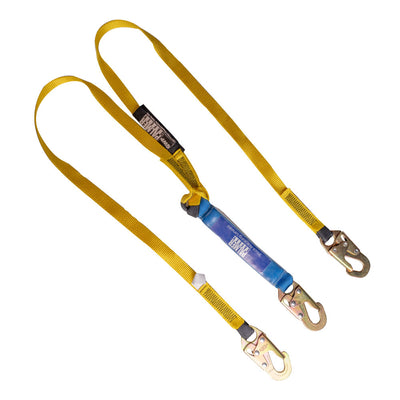
6 Ft. Double Lanyard, Blue Shock Absorber, Steel Snap Hooks
6 Ft. Double Lanyard, Blue Shock Absorber, Steel Snap Hooks - 3/4" is backordered and will ship as soon as it is back in stock.
Safe & Secure Payments

6 Ft. Double Lanyard, Blue Shock Absorber, Steel Snap Hooks - 3/4" is backordered and will ship as soon as it is back in stock.
Product Description
6 Ft. Double Lanyard with Blue Shock Absorber and Steel Snap Hooks — ANSI-Compliant Fall Arrest Protection
The Palmer Safety L111211 is a 6-foot shock-absorbing double lanyard designed for use in personal fall arrest, work positioning, restraint, and suspension systems. Built for contractors and trades professionals working at height, it features a polyester webbing body integrated with a blue shock absorber and steel snap hooks at all ends. The lanyard meets or exceeds ANSI Z359.1-1992 and is intended for use in construction, demolition, maintenance, oil production, inspection work, and confined space rescue applications.
Technical Specifications
| Specification | Details |
|---|---|
| SKU | L111211 |
| Length | 6 ft. |
| Type | Double lanyard with shock absorber |
| Hook Size | 3/4" |
| Hook Type | Steel snap hook |
| Standard Compliance | Meets or Exceeds ANSI Z359.1-1992 |
| Webbing Material | Polyester |
| Webbing Width | 1.18 in. ± 0.03 in. |
| Webbing Breaking Strength | 30 kN (Min) |
| Stitching Thread Material | High-tenacity polyamide |
| Stitching Thread Color | Black |
| Metal Component Material | Medium Carbon Steel (Hardness 35 to 42 HRC) |
| Metal Plating | Zinc Plated |
| Metal Finish | Shot blasted |
| Tensile Strength | MIN 22.2 kN |
| Gate Face Testing | MIN 1.0 kN |
| Side Load Testing | MIN 1.6 kN |
| Static Strength | 22.2 kN for 2 minutes |
| Dynamic Strength | Maximum breaking force does not exceed 8 kN; lanyard elongation does not exceed 42 inches from a 6-foot free fall |
The double-leg configuration allows workers to maintain 100% tie-off while moving between anchor points — a critical advantage over single-leg lanyards on leading-edge and sequential-anchor jobsites. The integrated blue shock absorber reduces arrest forces transmitted to the body, and the zinc-plated, shot-blasted medium carbon steel hardware provides corrosion resistance and durability in demanding field conditions.
Key Features & Benefits
Shock-Absorbing Design
The integrated shock absorber limits the maximum arrest force transmitted to the worker to no more than 8 kN during a 6-foot free fall, reducing the risk of injury at the moment of arrest. This is a critical performance requirement for any personal fall arrest system used in construction and industrial environments.
Double-Leg Configuration
With steel snap hooks at all lanyard ends, the double-leg design enables continuous 100% tie-off as workers clip to a new anchor before unclipping from the previous one. This eliminates unprotected transition moments that are common with single-leg lanyards.
High-Strength Polyester Webbing
The 1.18-inch-wide polyester webbing delivers a minimum breaking strength of 30 kN, providing a substantial safety margin above the forces encountered in a fall arrest event. Polyester construction resists UV degradation and maintains strength across a range of jobsite conditions.
High-Tenacity Polyamide Stitching
Black high-tenacity polyamide thread is used throughout the stitching, ensuring the load-bearing seams maintain integrity under dynamic arrest forces. The contrasting black color also allows for quick visual inspection of stitch condition during pre-use checks.
Medium Carbon Steel Hardware
Snap hooks are manufactured from medium carbon steel hardened to 35–42 HRC, zinc-plated and shot-blasted for corrosion resistance and surface durability. Gate face and side load testing minimums of 1.0 kN and 1.6 kN respectively confirm the hooks resist accidental opening under multi-directional loading.
ANSI Z359.1-1992 Compliance
The lanyard meets or exceeds ANSI Z359.1-1992, the established American National Standard for personal fall arrest systems. Compliance with this standard supports OSHA fall protection program requirements and provides documentation for safety audits and site inspections.
Common Applications
Construction
Used by ironworkers, framers, and general construction crews working at elevation where continuous fall protection and anchor-to-anchor transitions are required.
Demolition
Provides fall arrest protection for workers on demolition sites where structural anchor points may change frequently, making the double-leg 100% tie-off capability especially valuable.
Maintenance and Inspection Work
Suited for maintenance technicians and inspectors working on elevated structures, towers, or equipment where movement between anchor points is routine.
Oil Production
Designed for use in oil production environments where workers must maintain fall protection while navigating elevated platforms and equipment.
Confined Space Rescue
The lanyard's compliance with ANSI Z359.1-1992 and its robust hardware make it appropriate for use as part of confined space rescue system configurations.
Work Positioning and Restraint
Can be configured for restraint applications — preventing the user from reaching a fall hazard — or for work positioning to support the user at a work location, in addition to its primary fall arrest function.
Compatible Materials
- Steel anchor points and D-rings
- Self-retracting lifelines (when used as a D-ring extension assembly with energy absorber)
- Full-body harnesses with dorsal D-ring attachment
- Body belts (for restraint and work positioning applications)
Product Documents
Application Instructions
Pre-Use Inspection
- Inspect the polyester webbing for cuts, abrasions, burns, chemical damage, or discoloration before each use.
- Check the black polyamide stitching for broken, cut, or pulled threads at all load-bearing seams.
- Inspect the shock absorber housing for signs of deployment (partial or full deployment indicates the lanyard must be removed from service immediately).
- Verify that all steel snap hooks open and close freely, that the gate locks positively, and that there is no visible corrosion, deformation, or cracking on the metal components.
Connection and Use
- Attach the lanyard's connector end to the dorsal D-ring of a properly fitted full-body harness or to an approved body belt for restraint/work positioning applications only.
- Connect the snap hook(s) to a qualified anchor point capable of supporting the required arrest forces.
- When moving between anchor points, clip the second leg to the new anchor before unclipping from the previous anchor to maintain 100% tie-off at all times.
- Ensure the snap hook gate is fully closed and locked before loading.
- Do not allow the lanyard to contact sharp edges, abrasive surfaces, or chemicals that could degrade the webbing.
After a Fall Event
- Remove the lanyard from service immediately after any fall arrest event — do not reuse.
- Inspect all components of the complete fall arrest system before returning any other components to service.
- Follow your organization's fall protection program procedures for post-fall inspection and equipment retirement.
Frequently Asked Questions
Q: What standard does this lanyard comply with?
A: The L111211 meets or exceeds ANSI Z359.1-1992, the American National Standard for personal fall arrest systems, lanyards, and deceleration devices.
Q: What is the maximum arrest force this lanyard will transmit during a fall?
A: During dynamic testing from a 6-foot free fall, the maximum breaking force transmitted does not exceed 8 kN, and lanyard elongation does not exceed 42 inches.
Q: Can this lanyard be used for work positioning or restraint, or only fall arrest?
A: According to the manufacturer's instructions, Palmer Safety lanyards are suitable for personal restraint, work positioning, suspension, and rescue systems, in addition to fall arrest applications.
Q: Why does this lanyard have two legs?
A: The double-leg design allows workers to maintain 100% tie-off while transitioning between anchor points — one leg remains connected to the current anchor while the second leg is clipped to the next anchor before the first is released.
Q: What should I do if the shock absorber has been deployed?
A: Any lanyard with a deployed or partially deployed shock absorber must be immediately removed from service and must not be reused. Deployment indicates the lanyard has arrested a fall and its energy-absorbing capacity has been consumed.
Q: What materials are used in the lanyard construction?
A: The webbing is polyester, the stitching thread is high-tenacity polyamide, and the snap hooks are medium carbon steel (hardness 35–42 HRC) with zinc plating and a shot-blasted finish.
-
Sale
Husqvarna
Husqvarna Hepa Dust Extractor - 130 H
Sale price $6,253.20 Was: Regular price $6,948.00 Save $694.80Unit price -
-
Sale
Husqvarna
Husqvarna K 540i Power Cutting Saw
Sale price $944.10 Was: Regular price $1,049.00 Save $104.90Unit price -
-
Sale
-
-
Sale
Husqvarna
Sale price $2,444.40 Was: Regular price $2,716.00 Save $271.60Unit price -
-
Sale
-
-
 Sale
SaleHusqvarna
Sale price $1,614.60 Was: Regular price $1,794.00 Save $179.40Unit price -
 Sale
SaleHusqvarna
Sale price$118,153.29 – $122,841.00Save up to $13,649.00Unit price -
Sale
Husqvarna
Sale price $5,635.80 Was: Regular price $6,262.00 Save $626.20Unit price -


