


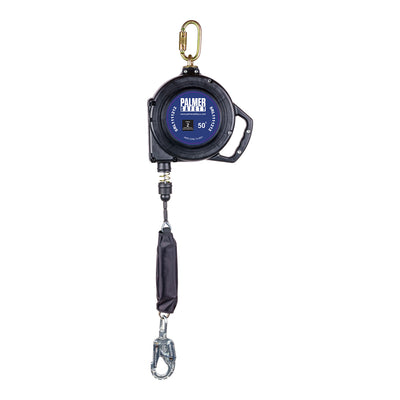
BEAST EDGE™ Series 50' SRL LE With Small Hook
BEAST EDGE™ Series 50' SRL LE With Small Hook - Overhead Anchorage is backordered and will ship as soon as it is back in stock.
Safe & Secure Payments

BEAST EDGE™ Series 50' SRL LE With Small Hook - Overhead Anchorage is backordered and will ship as soon as it is back in stock.
Product Description
BEAST EDGE™ Series 50' Self-Retracting Lifeline — Leading Edge Class 2 with Small Hook
The BEAST EDGE™ Series SRL1111212 is a 50-foot Class 2 Self-Retracting Lifeline (SRL) engineered specifically for leading edge applications where workers may be exposed to fall hazards at or near an unprotected edge. Built with a 7/32" galvanized steel wire rope lifeline and a swivel top composite housing, this unit is designed for overhead anchorage use and provides complete freedom of movement while automatically retracting slack to minimize free-fall distance. It is intended for use by contractors and trades professionals as part of a complete Personal Fall Arrest System (PFAS) including a full body harness and compatible anchorage connector.
Technical Specifications
| Specification | Details |
|---|---|
| SKU | SRL1111212 |
| SRD Series | Beast Edge |
| SRD Length | 50 ft. |
| SRD Type | Class 2, Cable, Overhead, Leading Edge (LE) |
| SRD Hook Type | Snap |
| Cable Material | Galvanized steel wire rope, diameter 7/32" |
| Minimum Breaking Strength (Cable) | 3,800 lbs. |
| Minimum Breaking Strength (Unit) | 3,000 lbs. |
| Housing | Swivel top composite housing, Black |
| Load Indicator Hook | 3/4" swivel steel snap hook with load indicator |
| Carabiner | 1/2" |
| Maximum Arresting Force | 1,800 lbs. |
| Average Arresting Force | 1,350 lbs. |
| Maximum Arrest Distance | 42 inches |
| User Weight Capacity | 130 lbs. minimum – 310 lbs. maximum (person, clothing, and tools combined) |
| Conforms To | Meets or Exceeds ANSI/ASSP Z359.14-2021 Class 2 |
ANSI SRL Specification Table — Full Model Series
| Model Number | Lifeline Material & Size | Lifeline Length | Max Arresting Force | Avg Arresting Force | Max Arrest Distance | ANSI/ASSP Z359.14-2021 Class |
|---|---|---|---|---|---|---|
| SRL622T | 6' Para-Aramid and UHMWPE, 13/18" width | 6 ft. | 1,800 lbs. | 1,350 lbs. | 42 inches | 2 |
| SRL8222T | 3/16" Galvanized Steel Cable | 8 ft. | 1,800 lbs. | 1,350 lbs. | 42 inches | 2 |
| SRL121122 | Dyneema Webbing (Black) 3/4" width | 6 ft. | 1,800 lbs. | 1,350 lbs. | 42 inches | 2 |
| SRL121122T | Dyneema Webbing (Black) 3/4" width | 6 ft. | 1,800 lbs. | 1,350 lbs. | 42 inches | 2 |
| SRL121132 | Dyneema Webbing (Black) 3/4" width | 6 ft. | 1,800 lbs. | 1,350 lbs. | 42 inches | 2 |
| SRL121132T | Dyneema Webbing (Black) 3/4" width | 6 ft. | 1,800 lbs. | 1,350 lbs. | 42 inches | 2 |
| SRL121142 | Dyneema Webbing (Black) 3/4" width | 6 ft. | 1,800 lbs. | 1,350 lbs. | 42 inches | 2 |
| SRL121142T | Dyneema Webbing (Black) 3/4" width | 6 ft. | 1,800 lbs. | 1,350 lbs. | 42 inches | 2 |
| SRL411212 | 7/32" Galvanized Steel Cable | 12 ft. | 1,800 lbs. | 1,350 lbs. | 42 inches | 2 |
| SRL411222 | 7/32" Galvanized Steel Cable | 12 ft. | 1,800 lbs. | 1,350 lbs. | 42 inches | 2 |
| SRL911212 | 7/32" Galvanized Steel Cable | 18 ft. | 1,800 lbs. | 1,350 lbs. | 42 inches | 2 |
| SRL711212 | 7/32" Galvanized Steel Cable | 30 ft. | 1,800 lbs. | 1,350 lbs. | 42 inches | 2 |
| SRL1111212 | 7/32" Galvanized Steel Cable | 50 ft. | 1,800 lbs. | 1,350 lbs. | 42 inches | 2 |
Required Fall Clearance Calculation (Overhead Anchorage)
| Diagram Point | Distance | Factors |
|---|---|---|
| A | 2 ft. | Deceleration Distance — Maximum allowable length of cable or web that may pay out from the SRD once deceleration of the user has begun and after a fall event occurs. |
| B | 1 ft. | D-ring Shift and Harness Stretch — Combined amount of Dorsal D-ring up-shift and harness webbing elongation during entire fall event. |
| C | 2 ft. | Safety Factor — Added length to account for other factors such as an improperly adjusted harness, actual worker height, or worker weight. |
| D | 5 ft. | Minimum Fall Clearance Required (Subtotal) for direct overhead use of SRD (not accounting for Swing Fall); sum of A, B, and C only. |
| E | *** | Swing Fall — Additional Fall Clearance Calculation needed. Use Swing Fall Chart. |
| D + E | — | Required Fall Distance |
The SRL1111212 is specifically rated for leading edge use — a demanding classification that standard SRLs cannot meet — making it the appropriate choice when workers must operate at or near an unprotected floor or roof edge. The 50-foot galvanized steel cable provides a significantly larger working radius than a standard 6-foot lanyard, allowing full freedom of movement across large work areas without compromising fall arrest performance. The integrated load indicator on the snap hook provides immediate visual confirmation of a fall event, simplifying post-incident equipment retirement decisions.
Key Features & Benefits
Leading Edge (LE) Rated — Class 2
This SRL is specifically designed and rated for leading edge applications where the lifeline may contact or pass over an unprotected edge during a fall. Class 2 certification under ANSI/ASSP Z359.14-2021 confirms the unit meets the more stringent performance requirements for edge exposure scenarios, giving contractors the correct tool for roofing, structural steel, and elevated deck work near open edges.
7/32" Galvanized Steel Wire Rope Lifeline
The galvanized steel cable construction provides superior abrasion and cut resistance compared to webbing-based SRLs, which is critical when the lifeline may contact concrete, steel edges, or other abrasive surfaces during a fall event. With a minimum cable breaking strength of 3,800 lbs., the lifeline itself exceeds the unit's rated minimum breaking strength of 3,000 lbs., providing a built-in margin of structural integrity.
Swivel Top Composite Housing
The swivel eye at the anchorage end allows the unit to rotate freely as the worker moves around the anchor point, preventing cable twist and reducing wear on the lifeline. The robust composite housing is durable and lightweight, reducing fatigue during extended use on the job site.
Self-Locking Swivel Snap Hook with Load Indicator
The 3/4" swivel steel snap hook features an integrated load indicator that provides a clear visual signal if the unit has been subjected to a fall arrest event. This allows supervisors and workers to immediately identify and remove from service any SRL that has been loaded, in compliance with manufacturer and OSHA requirements for post-fall equipment retirement.
50-Foot Working Range
The 50-foot cable length extends the effective working radius far beyond what a standard 6-foot lanyard allows, making this unit suitable for large open decks, rooftops, and structural steel erection where workers must travel significant distances from the anchor point. The self-retracting mechanism continuously takes up slack, keeping the lifeline taut and minimizing free-fall distance at any position within the work zone.
Includes Carabiner and Tag Line
The unit ships with a 1/2" carabiner and tag line to support proper connection and help prevent improper use in the field. This ensures the system can be deployed correctly without requiring additional hardware procurement on the job site.
Common Applications
Roofing and Leading Edge Work
Designed specifically for use near unprotected roof edges, this Class 2 LE-rated SRL is the appropriate fall arrest device when workers must approach or work at the perimeter of a roof or elevated deck.
Structural Steel Erection
The galvanized steel cable and robust composite housing withstand the abrasive and impact conditions common in structural steel work, where lifelines may contact steel members or edges during a fall event.
Elevated Concrete Deck Construction
The 50-foot cable provides the working range needed on large concrete deck pours and elevated slab work, where workers must move freely across the structure while remaining protected from open edge fall hazards.
Stationary Overhead Anchorage Use
When mounted to an approved fixed overhead anchorage, the SRL extends as the user moves away from the anchor point and retracts as the user returns, providing continuous fall protection across the full working radius.
Mobile Horizontal Lifeline (HLL) and Rail Systems
The SRL may also be used in a mobile manner, traveling along a steel cable, rope, or fixed rail between anchorage connectors, provided all HLL or rail system applications are installed and supervised by a Qualified Person.
Compatible Materials
- Concrete surfaces and elevated decks
- Structural steel members and framing
- Wood framing and roof decking
- Fixed overhead anchorage connectors (rigid and flexible)
- Horizontal lifeline (HLL) cable and rail systems
- Full body harnesses with dorsal D-ring attachment
Product Documents
- Download Tech Sheet (Current Model)
- Download Manual (Current Model)
- Download Declaration of Conformance (Current Model)
- Download Tech Sheet (Previous Model)
- Download Manual (Previous Model)
- Download Declaration of Conformance (Previous Model)
- SRL170 Dual Leg SRD Converter Installation Guide
Application Instructions
Pre-Use Inspection
- Inspect the SRL for defects, damage, or deterioration before each use.
- Verify the manufacturer's label is legible and present. If missing or illegible, remove from service immediately.
- Confirm the load indicator hook shows no evidence of a prior fall arrest event. Remove from service if activated.
- Check the galvanized steel cable for kinks, broken wires, corrosion, or abrasion damage.
- Inspect the housing, swivel eye, snap hook, and carabiner for deformities, unusual wear, or deterioration.
- Verify all connectors are self-closing and self-locking and capable of supporting a minimum of 5,000 lbs.
System Setup — Overhead Anchorage
- Confirm the anchorage point is rated for the loads imposed by a fall arrest system and is located directly overhead of the work area whenever possible.
- Attach the swivel top of the SRL to the approved overhead anchorage connector using the carabiner or appropriate connector. Confirm full engagement visually — do not rely on feel alone.
- Connect the 3/4" snap hook at the lifeline end to the dorsal D-ring of the worker's full body harness. Confirm the hook is fully locked.
- Ensure the tag line is properly managed to prevent interference with the lifeline during use.
- Calculate required fall clearance: minimum 5 ft. for direct overhead use (2 ft. deceleration + 1 ft. D-ring shift/harness stretch + 2 ft. safety factor), plus additional clearance for swing fall if the worker will not remain directly below the anchorage point. Refer to the Swing Fall Additional Fall Clearance Chart.
- Confirm adequate clearance exists between the worker's lowest point of travel and the nearest lower level or obstruction before beginning work.
During Use
- Move freely within the work zone — the SRL will extend and retract automatically as you move toward or away from the anchor point.
- Work as close to the anchorage point as possible to minimize swing fall risk.
- Do not use near sharp edges such as sheared metals, abrasive-disk-cut metals, or flame-cut metals that could abrade the cable or energy absorber.
- Do not use around moving machinery, electrical hazards, or in high-temperature environments near welding or metal cutting without appropriate precautions.
- Only one person may be connected to the SRL at a time.
Post-Use and Storage
- If the SRL has been subjected to a fall arrest event, remove it from service immediately and contact your distributor or Palmer Safety regarding replacement.
- Clean the equipment of all dirt, corrosives, and contaminants after use. Use mild soap and water if wiping alone is insufficient. Rinse, wipe, and hang to dry.
- Store the SRL away from heat, light, excessive moisture, oil, chemicals, and other degrading elements.
- Record the date of inspection and any serial number in the owner's Inspection Log.
- Formal inspections by a Competent or Qualified Person must be conducted at least semi-annually.
- Repairs must be performed only by Palmer Safety or persons or entities authorized in writing by Palmer Safety.
Safety Data Summary
Hazard Information
- Improper use, modification, or substitution of components may result in serious injury or death.
- Equipment subjected to a fall arrest event must be immediately removed from service.
- Swing falls — occurring when the anchorage is not directly above the fall point — significantly increase required clearance and risk of striking an object, potentially causing serious injury or death.
- Electrical hazard: moisture absorbed by the lifeline may provide a path for electrical current; use caution near high-voltage power lines.
- Chemical and heat damage may be difficult to detect; replace lifeline periodically when working in corrosive or high-temperature environments.
- Hot sparks and slag from welding or metal cutting can damage the SRL; protect the unit when working near such activities.
- Locking speed may be reduced in confined or cramped spaces, or on low-pitched roofs where a worker may slide rather than fall; a clear fall path is required for positive locking.
- Do not use near sharp edges such as sheared, abrasive-disk-cut, or flame-cut metals, or very abrasive concrete or stone edges.
- Pregnant women and minors must not use this equipment.
- Consult a physician if there is any reason to doubt a user's ability to safely withstand fall arrest forces.
Personal Protective Equipment
- Full body harness with dorsal D-ring attachment point required.
- Compatible self-locking snap hooks and carabiners rated to a minimum of 5,000 lbs. required.
- Additional PPE as required by site conditions and applicable OSHA regulations.
Safe Handling
- Do not alter the equipment in any way.
- Do not use the SRL for towing, hoisting, or any purpose other than personal fall arrest.
- Do not expose to chemicals, caustic environments, or high levels of organic acids or bases without consulting Palmer Safety.
- Do not connect two or more connectors to a single D-ring.
- Do not connect a connector in a way that results in a load on its gate.
- Visually confirm full engagement of all connectors before use — do not rely on feel alone.
- A rescue plan and the means to implement it must be in place before using this equipment.
- All equipment must be inspected before each use and formally inspected by a Competent or Qualified Person at least semi-annually.
- Any product exhibiting deformities, unusual wear, or deterioration must be immediately discarded.
- Leaving the SRL in a corrosive environment for extended periods is not warranted; more frequent inspections and servicing are required in corrosive conditions.
Frequently Asked Questions
Q: What makes this SRL suitable for leading edge applications when a standard SRL is not?
A: This unit is rated Class 2 under ANSI/ASSP Z359.14-2021, which specifically addresses leading edge use where the lifeline may contact or pass over an unprotected edge during a fall. Standard Class 1 SRLs are not rated for this scenario. The 7/32" galvanized steel cable also provides greater abrasion and cut resistance than webbing lifelines when contact with a concrete or steel edge is possible.
Q: What is the maximum user weight capacity for this SRL?
A: The SRL is rated for users with a combined weight (person, clothing, and tools) of 130 lbs. minimum and 310 lbs. maximum. Only one person may be connected at a time.
Q: What is the minimum fall clearance required when using this SRL with an overhead anchorage?
A: A minimum of 5 feet of clearance is required for direct overhead use (2 ft. deceleration distance + 1 ft. D-ring shift and harness stretch + 2 ft. safety factor). Additional clearance must be calculated for swing fall scenarios using the Swing Fall Additional Fall Clearance Chart when the worker is not directly below the anchorage point.
Q: What should I do if the SRL has been involved in a fall arrest event?
A: Remove the equipment from service immediately. The load indicator on the snap hook will provide visual confirmation of a fall event. Contact your distributor or Palmer Safety directly regarding replacement policies for components involved in a fall incident. Do not return the unit to service.
Q: How often must this SRL be formally inspected?
A: Formal inspections must be conducted by a Competent or Qualified Person at least semi-annually, in addition to user inspection before each use. The date of first inspection and any serial number must be recorded in the owner's Inspection Log.
Q: Can this SRL be used on a horizontal lifeline or rail system?
A: Yes. The SRL may be used in a mobile manner, traveling along a steel cable, rope, or fixed rail between anchorage connectors. All HLL or rail system applications, installation, and use must be under the supervision of a Qualified Person.
Q: Can repairs be made to this SRL in the field?
A: No. Repairs must be performed only by Palmer Safety or persons or entities authorized in writing by Palmer Safety. Any product exhibiting deformities, unusual wear, or deterioration must be immediately removed from service and discarded or returned to the manufacturer.
-
Sale
Husqvarna
Husqvarna Hepa Dust Extractor - 130 H
Sale price $6,253.20 Was: Regular price $6,948.00 Save $694.80Unit price -
-
Sale
Husqvarna
Husqvarna K 540i Power Cutting Saw
Sale price $944.10 Was: Regular price $1,049.00 Save $104.90Unit price -
-
Sale
-
-
Sale
Husqvarna
Sale price $2,444.40 Was: Regular price $2,716.00 Save $271.60Unit price -
-
Sale
-
-
 Sale
SaleHusqvarna
Sale price $1,614.60 Was: Regular price $1,794.00 Save $179.40Unit price -
 Sale
SaleHusqvarna
Sale price$118,153.29 – $122,841.00Save up to $13,649.00Unit price -
Sale
Husqvarna
Sale price $5,635.80 Was: Regular price $6,262.00 Save $626.20Unit price -


