


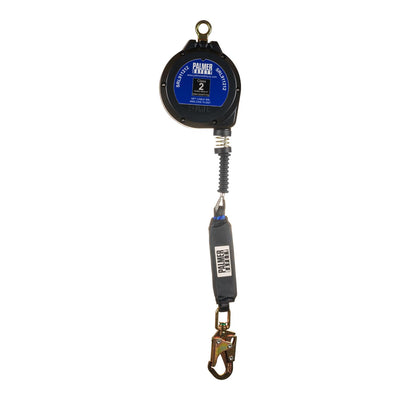
BEAST EDGE™ Series 18' Leading Edge SRL With 3/4" Load Indicating Hook
BEAST EDGE™ Series 18' Leading Edge SRL With 3/4" Load Indicating Hook is backordered and will ship as soon as it is back in stock.
Safe & Secure Payments

BEAST EDGE™ Series 18' Leading Edge SRL With 3/4" Load Indicating Hook is backordered and will ship as soon as it is back in stock.
Product Description
BEAST EDGE™ Series 18' Leading Edge SRL — 3/4" Load Indicating Hook for Sharp-Edge Fall Protection
The BEAST EDGE™ Series 18 ft. Self-Retracting Lifeline (SRL) is a Class 2 leading edge fall arrest device engineered for contractors working in environments where the lifeline may contact a structural edge during a fall event. Built around a 7/32" galvanized steel wire rope and a swivel-top composite housing, this SRL is designed to be used as part of a complete Personal Fall Arrest System (PFAS) including a full body harness and approved anchorage connector. The unit ships with a 1/2" carabiner and is rated for users with a combined weight (person, clothing, and tools) of 130–310 lbs. It meets or exceeds ANSI Z359.14-2021 Class 2 requirements.
Technical Specifications
| Specification | Details |
|---|---|
| SKU / Model Number | SRL911212 |
| SRD Series | Beast Edge |
| SRD Length | 18 ft. |
| SRD Type | Cable, Overhead, Leading Edge (LE) |
| SRD Hook Type | Snap |
| Cable Material | 7/32" Galvanized steel wire rope |
| Housing | Swivel top composite housing, black |
| Hook Size | 3/4" load indicating hook |
| Included Accessory | 1/2" carabiner |
| Minimum Breaking Strength | 3,000 lbs. |
| Maximum Arresting Force | 1,800 lbs. |
| Average Arresting Force | 1,350 lbs. |
| Maximum Arrest Distance | 42 inches |
| User Capacity | 130 – 310 lbs. (combined weight: person, clothing, tools) |
| Webbing Material | Polyester |
| Conforms To | Meets or Exceeds ANSI Z359.14-2021 Class 2 |
Unlike standard overhead SRLs, the BEAST EDGE™ is specifically rated for leading edge applications where the lifeline may run over a structural edge during a fall — a scenario that can sever or damage conventional cable lifelines. The 3/4" load indicating hook provides a visible indicator of impact loading, allowing supervisors and users to quickly identify units that must be removed from service after a fall event, reducing the risk of unknowingly redeploying compromised equipment.
Key Features & Benefits
Leading Edge Rated (Class 2)
This SRL is certified to ANSI Z359.14-2021 Class 2, meaning it is tested and approved for use where the lifeline may contact a leading edge during a fall. Contractors working on structural steel, concrete decks, or elevated floor openings can deploy this unit with confidence that the cable and energy absorber are rated for edge-contact scenarios.
7/32" Galvanized Steel Wire Rope Lifeline
The galvanized steel cable provides superior abrasion and cut resistance compared to synthetic webbing lifelines, making it the appropriate choice for sharp-edge and rough-surface environments. Galvanized construction also offers corrosion resistance for outdoor and exposed jobsite conditions.
3/4" Load Indicating Hook
The self-locking snap hook incorporates a load indicator that activates upon fall arrest, giving a clear visual signal that the unit has been subjected to fall forces and must be removed from service. This feature supports compliance with the manufacturer's requirement to retire any equipment involved in a fall event.
Swivel Top Composite Housing
The swivel anchorage eye allows the housing to rotate freely as the user moves, reducing torsional stress on the lifeline and anchorage connection. The composite housing keeps overall weight low while providing durable protection for the internal retraction and braking mechanism.
18 ft. Working Range
The 18 ft. cable extends the effective working radius well beyond what a standard 6 ft. shock-absorbing lanyard allows, giving workers greater freedom of movement on large deck areas, structural steel, or elevated platforms without sacrificing fall arrest performance.
Integrated Shock Pack / Energy Absorber
The unit includes an internal shock pack (energy absorber) that limits the Maximum Arresting Force to 1,800 lbs. and the Average Arresting Force to 1,350 lbs., keeping arrest forces within ANSI Z359.14-2021 Class 2 limits and reducing the risk of injury to the worker during a fall event.
Includes 1/2" Carabiner
A 1/2" carabiner is included in the box, providing a ready-to-use connecting subsystem for attaching the SRL to an approved anchorage connector. All connectors used with this system must be self-closing and self-locking and capable of supporting a minimum of 5,000 lbs.
Common Applications
Structural Steel Erection
Leading edge-rated cable construction makes this SRL suitable for ironworkers and steel erectors where the lifeline may contact beam flanges or column edges during a fall event.
Concrete Deck and Floor Opening Work
Workers installing rebar, formwork, or concrete on elevated decks with open edges benefit from the 18 ft. working range and the cable's resistance to abrasion against concrete surfaces.
Overhead Anchorage — Stationary Use
When mounted to a fixed overhead anchorage connector, the SRL extends as the user moves away from the anchor point and retracts automatically as the user returns, providing continuous fall protection without manual adjustment.
Horizontal Lifeline and Rail Systems — Mobile Use
The SRL may be used in a mobile configuration traveling along a steel cable, rope, or fixed rail between anchorage connectors, provided the HLL or rail system installation and use is supervised by a Qualified Person.
General Construction at Elevation
Any elevated work task where a standard 6 ft. lanyard does not provide adequate working range — such as roofing, bridge work, or elevated platform tasks — is a candidate application for this 18 ft. SRL.
Compatible Materials
- Structural steel (beams, columns, grating)
- Concrete decks and elevated slabs
- Wood framing and structural lumber
- Fixed steel cable, rope, or rail horizontal lifeline systems
- Approved rigid and flexible anchorage connectors rated for fall arrest
Product Documents
- Tech Sheet — SRL911212 Class 2
- Instruction Manual — Class 2 Self Retracting Lifeline
- Declaration of Conformance — SRL911212 Class 2
- Dual Leg SRD Converter Installation Guide (SRL170)
Application Instructions
Pre-Use Inspection
- Inspect the SRL for defects, damage, or deterioration before each use. Remove from service immediately if any are found.
- Verify the manufacturer's label is legible and present. If missing or illegible, remove from service.
- Confirm the load indicator on the hook has not been activated. If the unit has been subjected to a fall arrest, remove from service immediately.
- Inspect the galvanized steel cable for kinks, broken wires, corrosion, or abrasion damage.
- Confirm the swivel top rotates freely and the housing shows no cracks or deformation.
System Setup — Overhead Anchorage (Stationary)
- Attach the swivel top of the SRL to an approved overhead anchorage connector rated for fall arrest. The anchorage must be capable of supporting the required system loads.
- Connect the 1/2" carabiner (included) or the 3/4" snap hook to the dorsal D-ring of a properly fitted full body harness.
- Confirm all connectors are fully engaged, self-locked, and free of false engagement. Visually verify each connection point.
- Do not connect two or more connectors to a single D-ring. Do not load any connector gate.
Fall Clearance Calculation — Overhead Anchorage
- Calculate minimum fall clearance as the sum of: Deceleration Distance (A = 2 ft.) + D-ring Shift and Harness Stretch (B = 1 ft.) + Safety Factor (C = 2 ft.) = Minimum Fall Clearance Subtotal (D = 5 ft.) for direct overhead use.
- If the user will not be working directly below the anchorage point, calculate additional swing fall clearance using Chart 1 (Swing Fall Additional Fall Clearance with Overhead Anchorage) in the instruction manual, referencing the lateral work zone radius (X-axis) and the SRD anchorage height above the dorsal D-ring (Y-axis).
- Add the swing fall additional clearance (E) to the subtotal (D) to determine total Required Fall Distance. Ensure adequate clearance to the nearest lower level or obstruction exists before beginning work.
System Setup — Mobile Use on Horizontal Lifeline or Rail
- Ensure the HLL or rail system installation and use is under the supervision of a Qualified Person.
- Attach the SRL to the traveling trolley or connector on the HLL or rail system per the HLL system manufacturer's instructions.
- Connect the hook end to the dorsal D-ring of the full body harness and confirm full engagement and locking.
Maintenance, Cleaning, and Storage
- After use, clean the SRL of all dirt, corrosives, and contaminants. Wipe clean or wash with mild soap and water if needed.
- Rinse thoroughly, wipe dry, and hang to dry completely before storage.
- Store in a location free from heat, direct light, excessive moisture, oil, chemicals, or other degrading elements.
- Repairs must be performed only by Palmer Safety or a person or entity authorized in writing by Palmer Safety. Do not attempt field repairs.
- Formal inspections by a Competent or Qualified Person must be conducted at least semi-annually. Record the date of first inspection and the serial number in the owner's Inspection Log.
Safety Data Summary
Hazard Information
- Equipment subjected to a fall arrest must be immediately removed from service — continued use after a fall event may result in serious injury or death.
- Swing falls (anchorage not directly overhead) significantly increase required fall clearance and risk of striking an object; minimize by working as close to the anchorage point as possible.
- Electrical hazard: moisture absorbed by the lifeline may provide a path for electrical current; use caution near high-voltage power lines.
- Chemical and heat hazard: acid, caustic chemicals, elevated temperatures, welding slag, and hot sparks can damage the SRL; inspect prior to each use in these environments.
- Corrosion hazard: prolonged exposure to ammonia, sewage, fertilizers, seawater, or other corrosive environments requires more frequent inspection and servicing.
- Locking speed hazard: obstructed falls, confined spaces, or low-pitched roofs (sliding rather than falling) may limit the speed at which the locking mechanism engages; a clear fall path is required for positive locking.
- Sharp edges: avoid very sharp edges such as sheared metals, abrasive-disk-cut metals, or flame-cut metals, and very abrasive surfaces such as concrete or stone, which may abrade the lifeline or energy absorber during a fall.
- Pregnant women and minors must not use this equipment.
- Consult a physician if there is any reason to doubt a user's ability to safely withstand fall arrest forces.
Personal Protective Equipment
- Full body harness (required as part of the PFAS)
- Approved anchorage connector (carabiner or equivalent, minimum 5,000 lbs. rated)
- Additional PPE as required by the specific work environment and applicable OSHA regulations
Safe Handling
- Do not alter the equipment in any way; repairs must be performed only by the manufacturer or authorized entities.
- Do not use for towing, hoisting, or any purpose other than personal fall arrest.
- Do not expose to chemicals that may have a harmful effect on the materials; contact Palmer Safety if uncertain about chemical compatibility.
- Protect all synthetic components from slag, hot sparks, open flames, and other heat sources.
- Never use natural fiber materials (manila, cotton) as part of the fall protection system.
- Ensure a rescue plan and the means to implement it are in place before beginning work at elevation.
- Only one person may be connected to the SRL at a time.
- Do not connect two or more connectors to a single D-ring; do not load any connector gate; confirm full engagement visually before use.
Frequently Asked Questions
Q: What makes this SRL a "leading edge" (Class 2) device, and why does that matter?
A: ANSI Z359.14-2021 Class 2 certification means the SRL has been tested for use where the lifeline may contact a structural edge during a fall event. Standard Class 1 SRLs are rated for overhead use only and are not tested for edge contact, which can sever or damage a conventional lifeline. The BEAST EDGE™ uses a 7/32" galvanized steel cable specifically to withstand the abrasion and cutting forces that can occur at a leading edge.
Q: What is the maximum user weight capacity?
A: The SRL is rated for users with a combined weight — including the person, clothing, and all tools — of 130 lbs. minimum and 310 lbs. maximum. No more than one person may be connected at a time.
Q: What does the load indicating hook do?
A: The 3/4" load indicating hook provides a visible indicator that activates when the hook has been subjected to fall arrest forces. If the indicator has been triggered, the unit must be removed from service immediately and not reused, per manufacturer requirements.
Q: How much fall clearance is required when using this SRL with a direct overhead anchorage?
A: The minimum fall clearance for direct overhead use is 5 ft. (sum of 2 ft. deceleration distance + 1 ft. D-ring shift and harness stretch + 2 ft. safety factor). If the user is working laterally away from the anchorage point, additional swing fall clearance must be calculated using the Swing Fall chart in the instruction manual.
Q: Can this SRL be used on a horizontal lifeline or rail system?
A: Yes. The SRL may be used in a mobile configuration traveling along a steel cable, rope, or fixed rail between anchorage connectors, provided the HLL or rail system installation and use is under the supervision of a Qualified Person.
Q: What should I do if the SRL has been involved in a fall?
A: Remove the unit from service immediately. Do not attempt to inspect and return it to service yourself. Contact your distributor or Palmer Safety regarding their replacement policies for components involved in a fall incident.
Q: How often must the SRL be formally inspected?
A: Formal inspections must be conducted by a Competent or Qualified Person at least semi-annually. In addition, the user must inspect the equipment before each use. The date of first inspection and the serial number must be recorded in the owner's Inspection Log.
-
Sale
Husqvarna
Husqvarna Hepa Dust Extractor - 130 H
Sale price $6,253.20 Was: Regular price $6,948.00 Save $694.80Unit price -
-
Sale
Husqvarna
Husqvarna K 540i Power Cutting Saw
Sale price $944.10 Was: Regular price $1,049.00 Save $104.90Unit price -
-
Sale
-
-
Sale
Husqvarna
Sale price $2,444.40 Was: Regular price $2,716.00 Save $271.60Unit price -
-
Sale
-
-
 Sale
SaleHusqvarna
Sale price $1,614.60 Was: Regular price $1,794.00 Save $179.40Unit price -
 Sale
SaleHusqvarna
Sale price$118,153.29 – $122,841.00Save up to $13,649.00Unit price -
Sale
Husqvarna
Sale price $5,635.80 Was: Regular price $6,262.00 Save $626.20Unit price -


